Contract Law, Contract law key cases, Revocation of an offer

Dickinson v Dodds (1876) 2 Ch D 46

Court: Court of Appeal

Fact

On Wednesday 10 June 1874 Mr Dodds offered to sell his house to Mr Dickinson for £800, he stated that the offer ‘ to be left open until Friday 9 am’.

On Thursday the defendant sold the house to a third party named Allan. The claimant heard about this through another third party called Berry. Nevertheless, before 9 am on Friday the Claimant handed the defendant his letter of acceptance. But the defendant said it was too late. Mr Dickinson sued for breach of contract.

Issue

Had the offer been withdrawn?

Judgment

No contract had been concluded between the parties. The offer had already been revoked by the communication from the third party.

Since the promise to keep the offer open for a period of time was not supported with consideration, there was no obligation to keep the offer open and the offeror can revoke the offer at anytime before acceptance. This statement supported in Routledge v Grant (1828) 4 Bing 635, 130 ER 920.

Note: The offer can be withdrawn at anytime before acceptance by the offeror or some other reliable sources. If the offer revoke through a third party the third party must be “objectively reliable”.

Contract Law, Contract law key cases, Formation Of Contract /Offer and Acceptance

R v Clark (1927) 40 C.L.R. 227

In order to create a contract it is necessary to act in reliance upon the promises when accepting it.

Court: High Court of Australia

Judge(s) sitting: Isaacs ACJ, Higgins, Starke JJ

Fact

Crown had offered a reward of £1000 for information leading to conviction of murderers of 2 policemen. The government also promised that a pardon might be available to any accomplice giving required information. Clarke was under suspicion of the murder by crown. After his arrest he panicked and provided the information required in order to reduce his own sentence, forgetting, at the time, about the reward. Government refused to pay the reward.

Issue

Was there a contract between Clarke and the Crown?

Judgment

It was held that he was not entitled to the £1000 reward, as Mr. Clarke did not act “in reliance upon the offer or with the intention of entering into any contract”. He had no intention to claim the reward at the time of providing the information, therefore, he did not accept the offer.

The court ruled further than not only was a contract not formed, but Clarke had not fulfilled the terms of the contract, the information should lead to arrest and conviction of two murderers but one of the murderers was arrested before Clark give the information.

Note: The present case suggests that if the offeree knew of the offer in the past but has forgotten about it, they are treated as never having known about it.

Contract Law, Contract law key cases, Formation Of Contract /Offer and Acceptance, Offer

Gibbons v Proctor [1891] 64 LT 594 (also reported as Gibson v Proctor 55 JP 616)

Fact

A reward of £25 had been advised for information leading to the conviction of the perpetrator of a particular crime. The advertisement stipulated that the information must be given to the Superintendent Penn. The claimant, a police officer, had already shared the required information to a colleague (without knowing about the reward) with instructions to forward it to superintendent Penn. Before the information reached the Superintendent, the police officer became aware of the offer. The claimant attempted to claim the reward.

Issue

Was the police officer entitled to the reward without prior knowledge of the offer?

Judgment

The claimant was entitled to the reward. This case held that advertisements of reward is treated as an offer and the acceptance was the supply of the information to Penn, and by the time when information reached Penn, the officer had become aware of the offer.

Contract law key cases, Formation Of Contract /Offer and Acceptance, Offer

Carlill v Carbolic Smoke Ball Co Ltd [1893] 1 Q.B. 256

Offer by advertisement

Court: Court of Appeal

Judge(s) sitting: Lindley LJ, Bowen LJ and AL Smith LJ

fact:

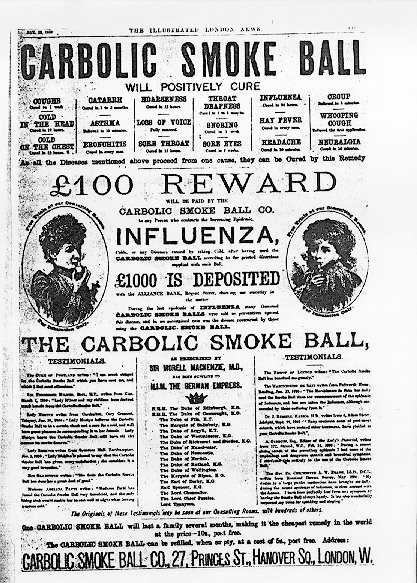
The defendants, who made and sold ‘smokeballs’ issued an advertisement in the newspaper stating that if anyone used their smokeballs in a specified manner and for a specified time and still caught flue, can claim £100 reward, and they deposited £1,000 in the bank to show their good faith. The plaintiff on the faith of the advertisement purchase one of the balls, and nevertheless ended up with flue after using the product in the specified manner. She claimed the £100, which company refused to pay. In resisting Mrs. Carlill claim, the Smoke Ball Company advanced many defences, among them (1)the argument that their statement was ‘a mere puff’ and was a mere marketing device which was never intended to be taken seriously. They also argued that(2) their advertisement was an invitation to treat as it is not possible to make a contract with the whole world.

Judgment:

(1) It was held that the advertisement was not a mere puff and £1000 deposit with Alliance Bank is a proof of his sincerity of promise to pay £100 reward in the event which he stated.

(2) It was held that the advertisement was an offer to the whole world and the contract was made with those people who performed the acts stipulated by the Smoke Ball Company ‘on the faith of the advertisement’, and the performance of the conditions is the acceptance of the offer. The claimant was therefore entitled to recover £100.

Note:

It sometimes argued that it would be unjust to allow a party to sue on a contract, if that party could not be also sued on it. Unilateral contracts are the contracts in which one party can sue the other party but not be sued. In the present case Smoke Ball Company cannot sue Mrs. Carlill for not using the smokeball.

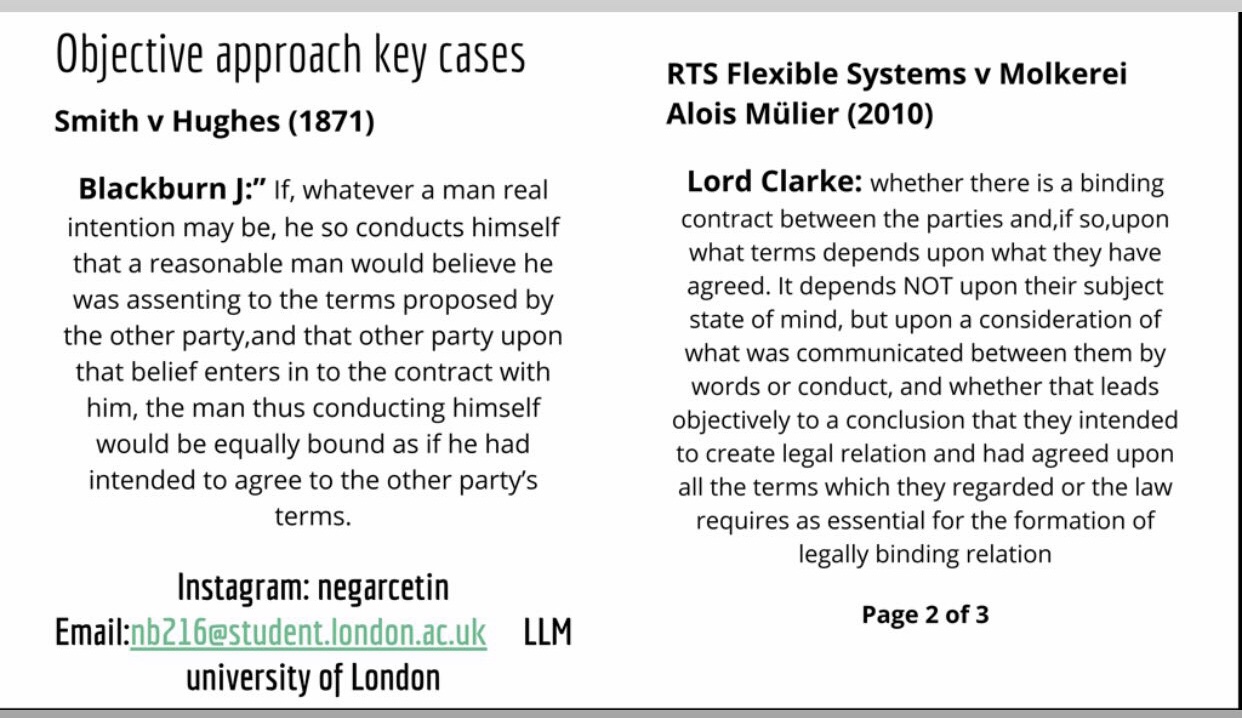
This case reaffirms objective approach takes by the court when assessing the issue of intention. Subjectively the company may not have intended to honour its promise , but objectively the £1000 deposit and the language used in the advertisement which was “clear, definite, and explicit, and left nothing open for negotiation” were clear evidence to the contrary.