Offer by advertisement
Court: Court of Appeal
Judge(s) sitting: Lindley LJ, Bowen LJ and AL Smith LJ
fact:
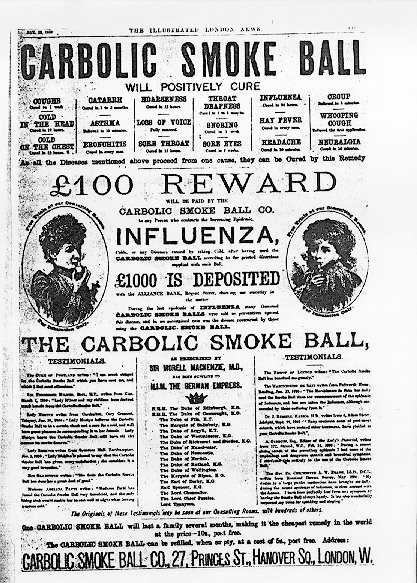
The defendants, who made and sold ‘smokeballs’ issued an advertisement in the newspaper stating that if anyone used their smokeballs in a specified manner and for a specified time and still caught flue, can claim £100 reward, and they deposited £1,000 in the bank to show their good faith. The plaintiff on the faith of the advertisement purchase one of the balls, and nevertheless ended up with flue after using the product in the specified manner. She claimed the £100, which company refused to pay. In resisting Mrs. Carlill claim, the Smoke Ball Company advanced many defences, among them (1)the argument that their statement was ‘a mere puff’ and was a mere marketing device which was never intended to be taken seriously. They also argued that(2) their advertisement was an invitation to treat as it is not possible to make a contract with the whole world.
Judgment:
(1) It was held that the advertisement was not a mere puff and £1000 deposit with Alliance Bank is a proof of his sincerity of promise to pay £100 reward in the event which he stated.
(2) It was held that the advertisement was an offer to the whole world and the contract was made with those people who performed the acts stipulated by the Smoke Ball Company ‘on the faith of the advertisement’, and the performance of the conditions is the acceptance of the offer. The claimant was therefore entitled to recover £100.
Note:
It sometimes argued that it would be unjust to allow a party to sue on a contract, if that party could not be also sued on it. Unilateral contracts are the contracts in which one party can sue the other party but not be sued. In the present case Smoke Ball Company cannot sue Mrs. Carlill for not using the smokeball.
This case reaffirms objective approach takes by the court when assessing the issue of intention. Subjectively the company may not have intended to honour its promise , but objectively the £1000 deposit and the language used in the advertisement which was “clear, definite, and explicit, and left nothing open for negotiation” were clear evidence to the contrary.
 Legal Resources / UK Law