Contract Law, Contract law key cases, Formation Of Contract /Offer and Acceptance

R v Clark (1927) 40 C.L.R. 227

In order to create a contract it is necessary to act in reliance upon the promises when accepting it.

Court: High Court of Australia

Judge(s) sitting: Isaacs ACJ, Higgins, Starke JJ

Fact

Crown had offered a reward of £1000 for information leading to conviction of murderers of 2 policemen. The government also promised that a pardon might be available to any accomplice giving required information. Clarke was under suspicion of the murder by crown. After his arrest he panicked and provided the information required in order to reduce his own sentence, forgetting, at the time, about the reward. Government refused to pay the reward.

Issue

Was there a contract between Clarke and the Crown?

Judgment

It was held that he was not entitled to the £1000 reward, as Mr. Clarke did not act “in reliance upon the offer or with the intention of entering into any contract”. He had no intention to claim the reward at the time of providing the information, therefore, he did not accept the offer.

The court ruled further than not only was a contract not formed, but Clarke had not fulfilled the terms of the contract, the information should lead to arrest and conviction of two murderers but one of the murderers was arrested before Clark give the information.

Note: The present case suggests that if the offeree knew of the offer in the past but has forgotten about it, they are treated as never having known about it.


Contract Law, Contract law key cases, Formation Of Contract /Offer and Acceptance, Offer

Gibbons v Proctor [1891] 64 LT 594 (also reported as Gibson v Proctor 55 JP 616)

Fact

A reward of £25 had been advised for information leading to the conviction of the perpetrator of a particular crime. The advertisement stipulated that the information must be given to the Superintendent Penn. The claimant, a police officer, had already shared the required information to a colleague (without knowing about the reward) with instructions to forward it to superintendent Penn. Before the information reached the Superintendent, the police officer became aware of the offer. The claimant attempted to claim the reward.

Issue

Was the police officer entitled to the reward without prior knowledge of the offer?

Judgment

The claimant was entitled to the reward. This case held that advertisements of reward is treated as an offer and the acceptance was the supply of the information to Penn, and by the time when information reached Penn, the officer had become aware of the offer.

Contract law key cases, Formation Of Contract /Offer and Acceptance, Offer

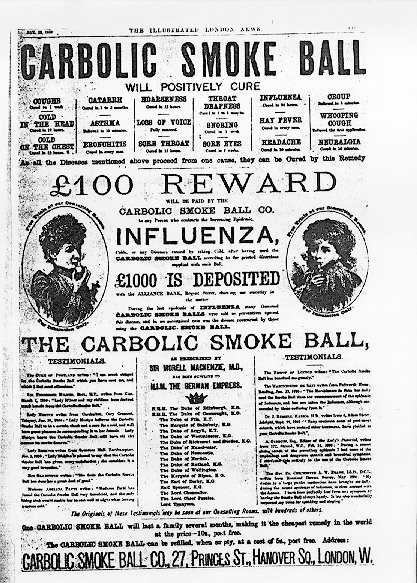
Carlill v Carbolic Smoke Ball Co Ltd [1893] 1 Q.B. 256

Offer by advertisement

Court: Court of Appeal

Judge(s) sitting: Lindley LJ, Bowen LJ and AL Smith LJ

fact:

The defendants, who made and sold ‘smokeballs’ issued an advertisement in the newspaper stating that if anyone used their smokeballs in a specified manner and for a specified time and still caught flue, can claim £100 reward, and they deposited £1,000 in the bank to show their good faith. The plaintiff on the faith of the advertisement purchase one of the balls, and nevertheless ended up with flue after using the product in the specified manner. She claimed the £100, which company refused to pay. In resisting Mrs. Carlill claim, the Smoke Ball Company advanced many defences, among them (1)the argument that their statement was ‘a mere puff’ and was a mere marketing device which was never intended to be taken seriously. They also argued that(2) their advertisement was an invitation to treat as it is not possible to make a contract with the whole world.

Judgment:

(1) It was held that the advertisement was not a mere puff and £1000 deposit with Alliance Bank is a proof of his sincerity of promise to pay £100 reward in the event which he stated.

(2) It was held that the advertisement was an offer to the whole world and the contract was made with those people who performed the acts stipulated by the Smoke Ball Company ‘on the faith of the advertisement’, and the performance of the conditions is the acceptance of the offer. The claimant was therefore entitled to recover £100.

Note:

It sometimes argued that it would be unjust to allow a party to sue on a contract, if that party could not be also sued on it. Unilateral contracts are the contracts in which one party can sue the other party but not be sued. In the present case Smoke Ball Company cannot sue Mrs. Carlill for not using the smokeball.

This case reaffirms objective approach takes by the court when assessing the issue of intention. Subjectively the company may not have intended to honour its promise , but objectively the £1000 deposit and the language used in the advertisement which was “clear, definite, and explicit, and left nothing open for negotiation” were clear evidence to the contrary.

Contract Law, Contract law key cases

Baird Textile Holdings Ltd v Marks & Spencer plc [2001] EWCA Civ 274

Court: Court of Appeal (Civil Division)

This case is one of the key cases in English Contract Law and is about the possibility of an implied contract after a course of dealings between two businesses.

Fact:

Marks & Spencer (M&S) had been in a relationship with Baird Textiles Holdings (BTH) for more than 30 years. On 19th October 1999 M&S without notice, ended all supply arrangement between them with effect from the end of current production season. BTH sued M&S on the grounds that the arrangement could only be terminated on reasonable notice of 3 years based on an allegation that there was an implied contract between them which M&S ‘would acquire garments from BTH in quantities and at prices which in all the circumstances were reasonable’. The problem was there was no express contract under which such a term could be said to have arisen.

Issue

Whether a contract could be implied based on the parties’ business relationships?

Judgment

The appeal was dismissed.

The Court of Appeal found that the terms would be too uncertain to be part of a valid contract. Furthermore, an argument of estoppel could not succeed pointing out that promissory estoppel is not capable of creating its own cause of action where one did not already exist.

Note:

In the present case both parties had a good long commercial relationship M&S had no intention to be bound by a contract so that they had maximum flexibility and BTH accepted the absence of any express contract but believed that the continuation of their long-term good relationship with M&S nevertheless implied a contract that would be terminable only after reasonable notice.

For the Court to be able to implied a contract at least two facts must be present. An intention to be legally bound, and an agreement with a sufficient certainty regarding the details. In addition, contracts are only implied when it is necessary which were not presented in this case.

Contract Law

RTS Flexible Systems Limited v Molkerei Alois Muller Gmbh [2010] UKSC 14

Court: Supreme Court

Justices: Lord Phillips, Lord Mance, Lord Collins, Lord Kerr, Lord Clarke

Fact

RTS a supplier of the automated packaging agreed to install an automated system in Muller’s factory. A letter of intent (LOI) was drawn up and was due to be in force for four weeks of the date of the LOI. This LOI had set out the contractual price for the machinery and stated that the final contract will be on Muller’s contractual terms with amendment. The letter contained a clause that the contract would not be binding until each party has executed a counterpart, sign and exchanged it with the other. The parties proceeded with the agreement but they never signed the final contract. A dispute arose, RTS refused to finish installing the machinery and Muller refused to make any further payment. The parties referred preliminary issues regarding the formation of the contract and incorporation of terms to the court for determination.

Issue:

Did the parties enter into a contract following the expiry of the LOI and, if so, on what terms?

Held:

The High Court ruled that there was a contract but on limited terms. The Court of Appeal reversed this, finding that there could be no contract until the agreement was signed. Finally, the Supreme Court stated that there is a binding contract. The parties reveal a joint wish to give effect to the terms of the negotiated deal without formal signing and the counterparts clause had been waived by their conduct. Lord Justice Clarke summarised the principles as to whether or not there was a binding contract, and, if so, what the terms might be as follows:
“45… It depends not upon their subjective state of mind, but upon a consideration of what was communicated between them by words or conduct, and whether that leads objectively to a conclusion that they intended to create legal relations and had agreed upon all the terms which they regarded or the law requires as essential for the formation of legally binding relations. Even if certain terms or economic or other significance to the parties have not been finalised, an objective appraisal of their words and conduct may lead to the conclusion that they did not intend agreement of such terms to be a precondition to a concluded and legally binding agreement.” [Emphasis added]

Note:

Letters of intent or agreement to agree are promises that the parties intend to enter to an agreement at a future date. These agreements are sometimes described as ‘subject to contract’ on the basis that the parties are still negotiating and do not intend to be bound until a formal written contract has been signed by both parties.

The statement of Lord Clark establish that test for deciding whether an agreement has been reached is objective rather than subjective.